Category Archives: Movies

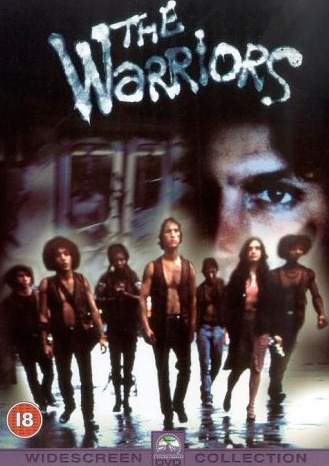
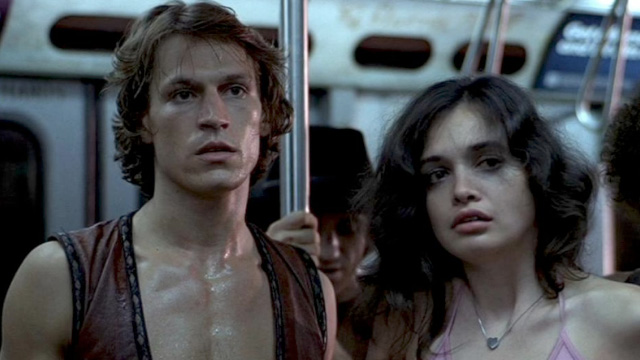
The Warriors. Just trying to get home alive.

The persistent winter weather failed to keep a nice crowd from turning up for Walter Hill’s cult classic! A small, Coney Island street gang suddenly finds themselves in a whole lot of trouble, and a long way from home. The Warriors played well at MovieNight, and our audience was pretty much evenly split between those who had somehow never seen it, and those who couldn’t wait to see it again.

Nice.

More about this film on IMDb imdb

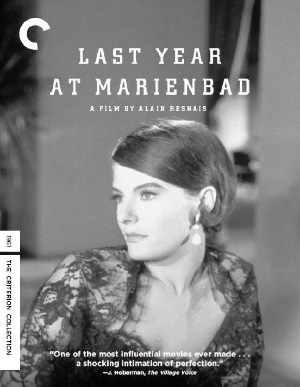
Last Year at Marienbad. What really happened?

This masterpiece from the late Alain Resnais (who passed away last Saturday in Paris at a respectable 95 years old), was not easy to sell to our  MovieNight peeps. Ultimately, though, we did get enough guests to make it a fun evening (thanks to the Barcelona crew!). Last Year at Marienbad is stark, obtuse, and repetitive… perfectly bizarre.  I was actually contemplating showing it again next week, without any explanation, or acknowledgement that I had shown it this week, just to play along with the surrealist theme, and the film’s unresolved plot. Did they in fact meet last year? We will never know.

More about this film on IMDb imdb

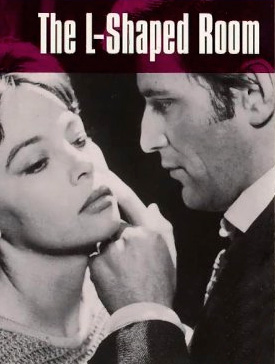
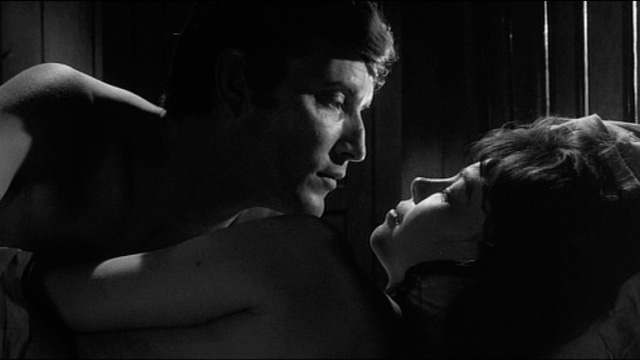
The L-Shaped Room. Womb at the top?

Thirty years later, it was a pleasure for me to revisit this treasure from British Cinema’s New Wave of the sixties, and a privilege to bestow upon the MovieNight family!  Most British folk of a certain age will be familiar with The L-Shaped Room, but for the large part it remains an obscure relic on this side of the pond.

After finding and watching a DVD, the thing that struck me was the courage of a young, unmarried, immigrant mother-to-be, played so well by Leslie Caron. At every turn, she faced pressure get rid of her baby. No spoiler alert here, just in case you do get a chance to see it, but the official trailer, however quaint, focused on the scandal of out-of-wedlock pregnancy, and left Ms. Caron looking rather feeble. In fact, she was rather fierce, and quite witty in her role. I felt that I should make my own trailer, and if you’re interested you can see it here.

Thanks to all who came out on another cold cold night. When will it warm up again?

More about this film on IMDb imdb

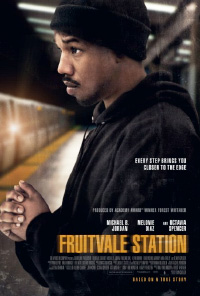
Fruitvale Station – BART Police at their finest.

I'll be back before you wake up.

Many times, the best feature debuts come from filmmakers who explore subjects about which they have a passion. With Ryan Coogler, the fire burns for Oscar Grant, a 22-year old who was shot while in police custody during the early morning hours of New Year’s Day 2009. The events, which occurred at the Fruitvale Station stop of the Bay Area’s BART line, sparked international outrage when cellphone video showing the incident made its way on line. For the movie, Coogler has stayed close to the historical record, although some pundits have argued that he softens the rough edges of Grant’s character to make the protagonist more sympathetic. By using a fly-on-the-wall approach, Coogler is able to tell his story in a straightforward style that gets the message across without seeming preachy. With the film hitting theaters in the wake of the George Zimmerman trial verdict, the questions Fruitvale Station asks about race have a heightened relevance than when the movie won both the Grand Jury Prize and the Audience Award at the 2013 Sundance Film Festival.

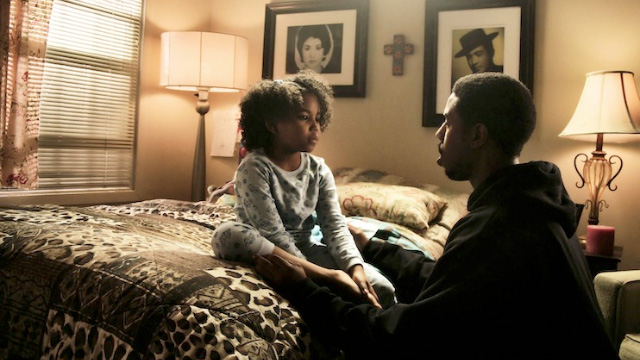
Fruitvale Station opens with about a minute of actual footage of events that night on the platform. The rest of the movie is a dramatization of the last day in the life of Oscar Grant (Michael B. Jordan). Until the final fifteen minutes, nothing dramatic happens to him. He’s trying to get a legitimate job to avoid having to return to selling drugs, an offense for which he is currently on parole. He spends time with his girlfriend, Sophina (Melonie Diaz), and their four-year old daughter, Tatiana (Ariana Neal). Since it’s his mother’s (Octavia Spencer) birthday, he and his family attend her party. Then he drops off Tatiana at his sister-in-law’s so he, his friends, and Sophina can head into San Francisco to see the fireworks.

Coogler infuses Fruitvale Station with an existential flavor. Because we in the audience are privy to how the story will end, every seemingly inconsequential action takes on a larger meaning. Many times when Oscar does something, it’s his “last.” Especially poignant is the moment when he says goodnight to Tatiana before departing on the journey from which he won’t return. To them in the moment, it’s just an ordinary goodbye kiss (with Oscar promising to take her to Chuck E. Cheese the next day). To us, it’s their farewell.

Coogler’s use of hand-held cameras adds a roughness to the proceedings that could not have been achieved through the use of more traditional cinematography. He avoids anything that might make Fruitvale Station seem slick or polished. He doesn’t want this to turn into a manipulative melodrama. In the end, the movie is less about Oscar than it is about his death. Our picture of the man is incomplete but the chronology of his last moments is not. Fruitvale Station makes a compelling statement about race relations in America during the early part of the 21st century. It also depicts yet another incident of police brutality. But some aspect of Oscar the person becomes submerged beneath Oscar the icon. Of course, there’s a reason behind this: had Oscar not been killed that night in that manner, no one outside his immediate circle would have known his name.

Much credit goes to lead actor Michael B. Jordan for his strong portrayal of the lead character. He gives Oscar presence and dignity. In supporting roles, Melonie Diaz and Octavia Spencer are also solid, allowing us to see Oscar in family-related circumstances that offer a perspective of a different side of his personality. If there’s one scene that goes a little too far in painting Oscar as a “good guy,” it’s the scene in the grocery store where he helps out a woman trying to decide what fish to buy. Of all the material in Fruitvale Station, this is the only scene that rings false.

Fruitvale Station may well be 2013’s “little engine that could” to make it all the way from a limited July release to capture an Oscar nomination. It’s a compelling tale that offers the opportunity for reflection and discussion about issues that have never really gone away and continue to lurk in the cultural background. Some may see Fruitvale Station as political but, to me, it tells the story of a tragedy that should be seen as such no matter what a person’s race, gender, creed, party affiliation, or religion might be.

Review by James Berardinelli for Reelviews

More about this film on IMDb imdb

Blue is the Warmest Color on Saturday Night.

I really wanted to show this movie, but thought it would be fun to show it somewhat spontaneously on a Satuday night. Of course, there was yet another snowfall, and since the email didn’t get sent until early afternoon, the audience was quite small. Still… the movie was liked. There has been all manner of talk about Blue is the Warmest Color, along many subject lines: It’s pornography. The sex scenes are gratuitous. The director took advantage of the young actresses. There were no actual Lesbians involved. (What next? Real serial killers in murder stories? Real doctors in medical dramas? Bollocks!) Some complain that there are too many close-up shots of Adèle’s drooling mouth. (We did have a bit of fun counting how many shots of her ass there were!)

After my second viewing, I stand by my opinion that this is a great movie, and a wonderful coming-of-age tale.

As the reviewer A.A.Dowd wrote in the A.V. Club review:

“As for the sex scenes, they’re as insanely erotic as advertised; it’s not just their frankness and duration that counts, but their emotional intensity too. While many movies make sex look either sleazy or pantomimed, here’s one that depicts it honestly—as a messy, sometimes ungraceful act of connection. For some, it may be impossible to separate these prolonged simulations, which were surely no picnic to film, from the allegations of unprofessionalism the actresses have leveled against Kechiche. But only a hopeless prude could confuse any of it for pornography. There’s too much raw emotion, too much fierceness and beauty, in the way Exarchopoulos and Seydoux embrace. How, in this day and age, could two women fucking inspire such hysteria, especially among otherwise enlightened cinephiles? It’s just sex, after all. The heavy stuff comes after, when passions cool and two people, once united in amorous appetite, have to figure out how to keep what they have alive.”

More about this film on IMDb imdb

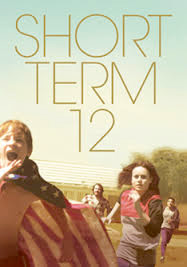
Short Term 12. Long term effect.

Two weirdos find each other.

It’s so easy to go wrong with a film like this. So easy to tart it up with sentiment, to turn up the mawkishness to an “11.” For an example of how badly wrong this sort of thing can go, just think Patch Adams, where the manipulation never stopped coming. Thankfully, none of that is true of Short Term 12, an emotionally authentic examination of the lives of those who live in and work at a children’s home where the lines between the inhabitants and the caretakers isn’t as clear as one might suppose. The sophomore feature effort from director Destin Cretton (remaking and expanding upon his 2008 short), this movie avoids the numerous landmines awaiting someone venturing into this territory and, as a result, emerges triumphant.

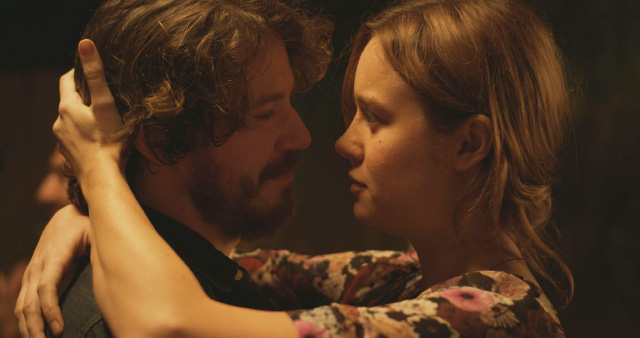
Well-crafted independent films like Short Term 12 often prove to be showcases for amazing unsung actors and actresses whose talents have thus far not been exposed in Hollywood’s spotlight. For Brie Larson, who has been around for more than ten years (mostly on television), this is a chance to shine. Combine it with her supporting roles in The Spectacular Now and Don Jon, and this has been a motion picture “coming out” year for Larson. Her work in Short Term 12 should get her noticed in much the same way that Amy Adams turned heads for Junebug, Jennifer Lawrence escaped relative obscurity with Winter’s Bone, and Elizabeth Olsen showed her talent in Martha Marcy May Marlene. Her performance as Grace represents an honest, multifaceted and completely believable portrayal of a character on the edge – one who has it together at the outset then sees her psyche gradually unravel as a result of series of blows. Riveting stuff, and Larson receives adept support from actor John Gallagher Jr., who plays her co-worker and lover, Mason, and Kaitlyn Dever as Jayden, a young charge whose tortured present mirrors Grace’s past.

Short Term 12 is really Grace’s story. She’s the leader of a quartet of workers who run the day-to-day care for the “short term” residents at a children’s group home. There’s an easygoing camaraderie among the four: Grace, Mason, Jessica (Stephanie Beatriz), and Nate (Rami Malek). Grace’s past, carefully buried, begins to surface as a result of the confluence of three events: her imprisoned father is about to be released from jail, she discovers she’s pregnant with Mason’s child, and a newcomer to the house, Jayden, shows signs of the same trauma Grace once experienced.

This is a character-driven movie that focuses predominantly on Grace’s inner life as well as the interactions she has with the other characters. There’s no melodrama and nothing is overwrought. Cretton elects to use handheld cameras to film the action. In some circumstances, this works, but its overuse leads to instances when sensitive viewers may begin to feel bouts of motion sickness. This isn’t the worst offender of the year when it comes to this dubious style of filmmaking but some viewers will almost certainly view it as a distraction, and that’s unfortunate. The production would have lost none of its power had a tripod occasionally been employed.

Short Term 12 is quiet and understated – two characteristics sadly lacking in bigger budget endeavors. Perhaps it’s the financial limitations that enable the cast to dig this deeply and really find their characters. There’s not a false note in any of the performances and we come away convinced that spending 90-odd minutes with Grace is a rewarding, if sometimes painful, experience. The biggest movies of 2013 have almost all been universally disappointing; it has been left up to indies like Short Term 12 to remind movie-goers that the true power of cinema lies not in bangs and flashes but in storytelling and character building.

Review by James Berardinelli for Reelviews

More about this film on IMDb imdb